Chatroulette vs Omegle
Two platforms defined random online chat. Both went all-in on video. Both paid the price. Here's the full story and where the smart users ended up.
Omegle and Chatroulette — if you were on the internet between 2009 and 2015, you used at least one of them. They were the two pioneers of random stranger chat, and for a while they were among the most visited websites on the planet. They took different approaches to the same idea, but both ended up in roughly the same place: overwhelmed by inappropriate content, outpaced by moderation challenges, and ultimately unable to sustain the original vision. One shut down. The other became a shadow of its former self. And the users? They moved on to platforms that learned from both their successes and failures.
The Omegle Story
Leif K-Brooks launched Omegle in March 2009. He was 18 years old. The concept was dead simple: connect two strangers for anonymous conversation. It launched with text-only chat. Video came later, and ironically, it was the video feature that both made Omegle famous and eventually destroyed it. At its peak, Omegle was handling over 50 million visits per month. College students used the .edu verification mode. Language learners used interest tags. Late-night thinkers used text mode for deep conversations with strangers. Then the problems started accelerating.
The Chatroulette Story
Andrey Ternovskiy launched Chatroulette in November 2009 — just months after Omegle. He was 17 years old, a high school student in Moscow. The twist: Chatroulette was video-only from the start. No text option. You turned on your webcam and got matched with a random stranger. The name said it all — it was roulette with faces. The site went from zero to 1.5 million daily users in under four months. It appeared on Good Morning America, got name-dropped by celebrities, and became a genuine cultural phenomenon. Then the same problem that would eventually kill Omegle hit Chatroulette first and harder.
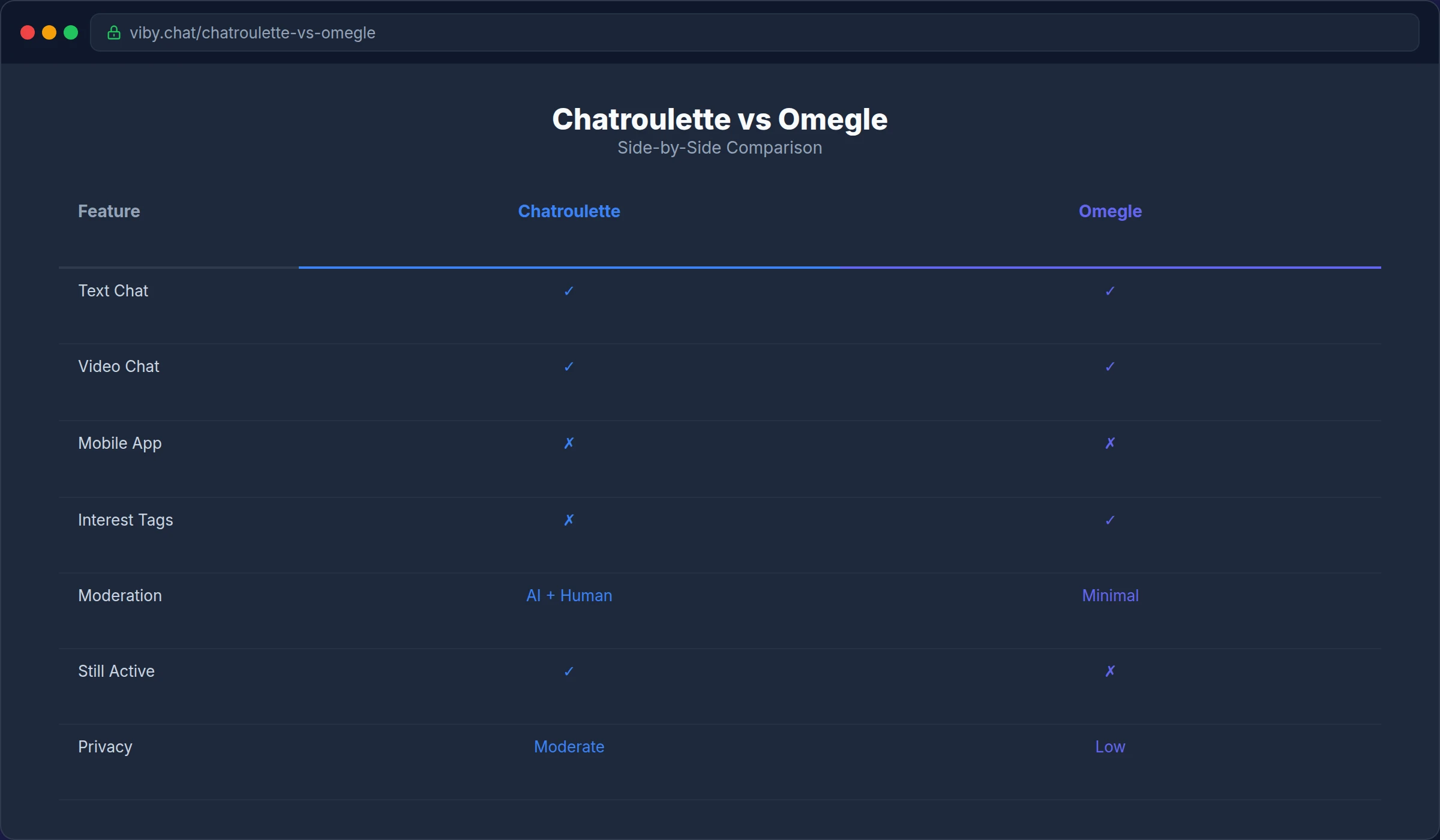
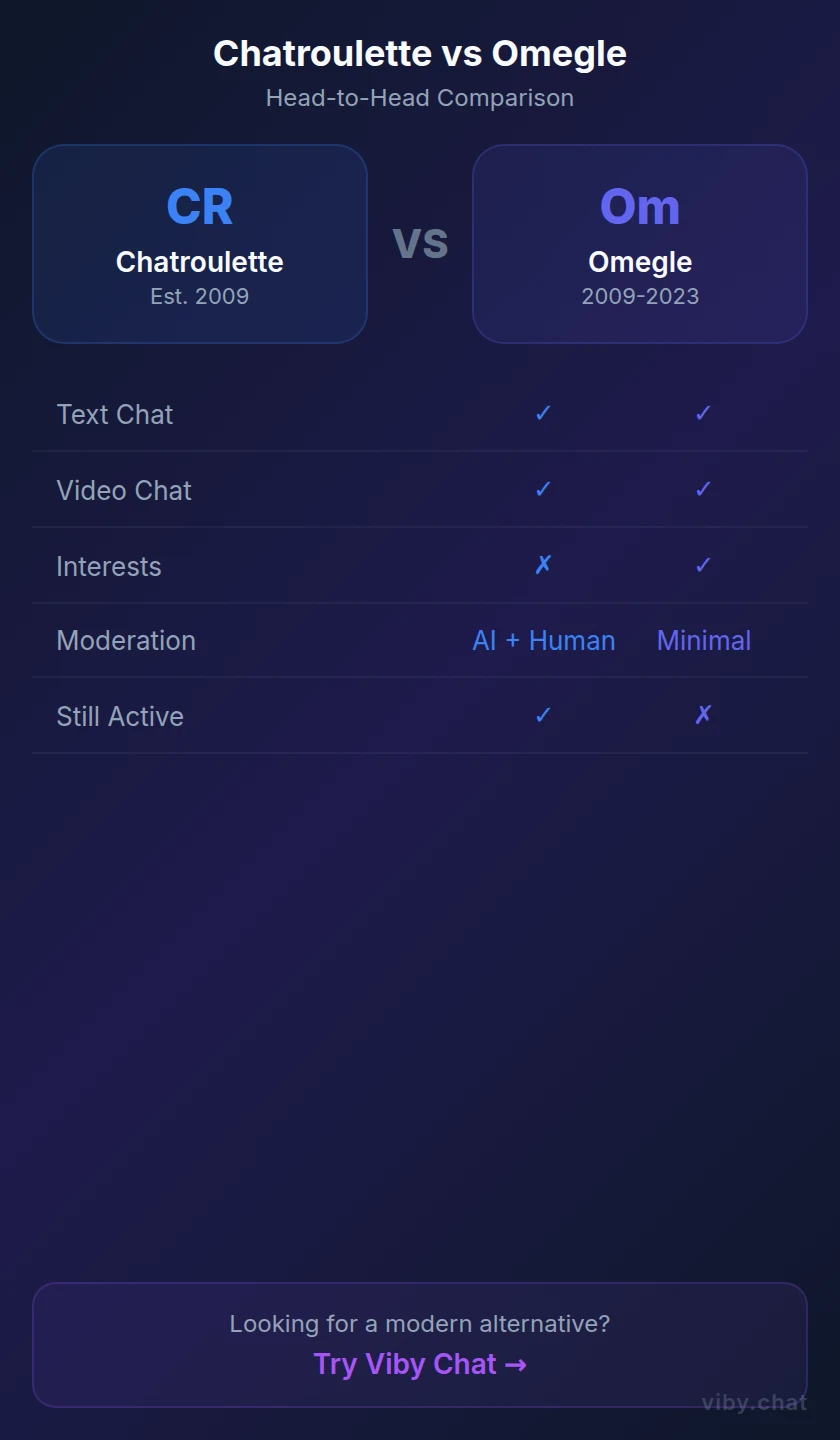
Head-to-Head Comparison
| Feature | Omegle | Chatroulette | Viby |
|---|---|---|---|
| Launch year | 2009 | 2009 | 2025 |
| Text chat | Yes | No | Yes |
| Video chat | Yes | Yes | No |
| Registration | No | No | No |
| Still online | No | Barely | Yes |
| Moderation | Medium | Low | Yes |
| Gender filter | No | No | Yes |
| Mobile friendly | Poor | Poor | Yes |
| Bot problem | High | Medium | Low |
Works Perfectly on Mobile
Viby is built mobile-first — chat from anywhere, anytime.
Why Both Platforms Declined
Omegle and Chatroulette share remarkably similar failure patterns. Understanding what went wrong is important for anyone choosing a random chat platform today:
Why Text Chat Is the Better Model
The biggest lesson from Omegle and Chatroulette is that video-first random chat creates problems that are almost impossible to solve. Text-first chat avoids most of these issues by design:
Privacy is built in. No face shown, no room visible, no background revealing your location. Text anonymity is real anonymity.
Moderation is tractable. Text can be filtered, scanned, and moderated at scale. Video requires either AI that doesn't work well enough or humans watching millions of streams — neither is practical.
Better conversations. Counterintuitive but true: removing video makes people focus on what they're saying. Conversations go deeper when you're not distracted by appearances.
Works on any device. Text chat needs minimal bandwidth and no camera. It works on a phone with a cracked screen as well as on a gaming PC.
Lower barrier to entry. Many people won't use video chat because of appearance anxiety, privacy concerns, or simply being in a public place. Text has none of these barriers.
Viby — Built on Their Lessons
Viby exists because of what Omegle and Chatroulette got wrong, not just what they got right. The core insight: people love talking to strangers, but video creates more problems than it solves. Viby is text-first by design. No webcam, no audio, no face. Just conversation. The matching is faster than Omegle ever was. The moderation is more effective because text is easier to filter. The gender and age preferences that Omegle never added are built in from day one. And it works on any device without installing anything.
Questions About Chatroulette vs Omegle
Omegle had more sustained traffic over its 14-year run. Chatroulette had a higher peak in early 2010 but declined much faster. At the time Omegle shut down, it still had around 50 million monthly visits.
Technically yes, but it's a shadow of its former self. Traffic is a tiny fraction of its peak, and the user experience has changed significantly with heavy filtering.
Omegle was specifically targeted by a lawsuit that the founder chose not to fight. Chatroulette avoided similar legal action partly because its user numbers had already declined significantly.
For the text chat experience that Omegle was known for, Viby is the closest modern equivalent. For video chat, sites like OmeTV still operate but face similar moderation challenges.
Text is safer, more private, and leads to better conversations. Video has the advantage of seeing someone's expressions, but the privacy and safety trade-offs are significant.
Articles
Omegle Alternatives
Looking for Omegle alternatives? Here are the best random chat sites still working in 2026. Free, anonymous, and no sign-up required.
What Happened to Omegle
The full story of why Omegle closed on November 8, 2023. Lawsuits, moderation failures, and where former users went next.
Viby vs OmeTV
Viby vs OmeTV compared: text vs video, privacy, matching, and real experience. Find out which random chat platform fits you.
Random Chat, Done Right
The best parts of Omegle and Chatroulette without the problems that killed them. Text-first, private, and actually moderated.